Informing Today, Inspiring Tomorrow

Informing Today, Inspiring Tomorrow
King Charles and Prince Edward, A Nation’s Birth, Papua New Guinea, 1975 to 2025
The Dawn of a Nation
As midnight passed into dawn on 16 September 1975, the air above Port Moresby shimmered with anticipation. Sounds echoed from villages, lanterns flickered along dusty roads, and thousands gathered on Independence Hill to watch their country take its first breath as a free nation.
A day before, the Australian flag was lowered at sunset on 15 September, 1975. The next day, the red, black, and gold flag of Papua New Guinea rose to the sound of the new national anthem, “O Arise, All You Sons.” In the crowd stood chiefs from villages, mothers in meri blouses holding sleeping babies, and youths waving flags made of cloth and paint. Many in traditional outfit, with colored body paint, feathers, grass skirts, shell jewellery and headdresses. People in the crowd were weeping with joy, cheering and dancing.
At the podium, Prince Charles, a 26-year-old royal envoy representing Queen Elizabeth II, stood poised. His duty was simple yet profound, to read the Queen’s message of goodwill and formally recognize PNG’s sovereignty. His presence was not an act of rule, but of respect, a young prince witnessing the birth of a nation.
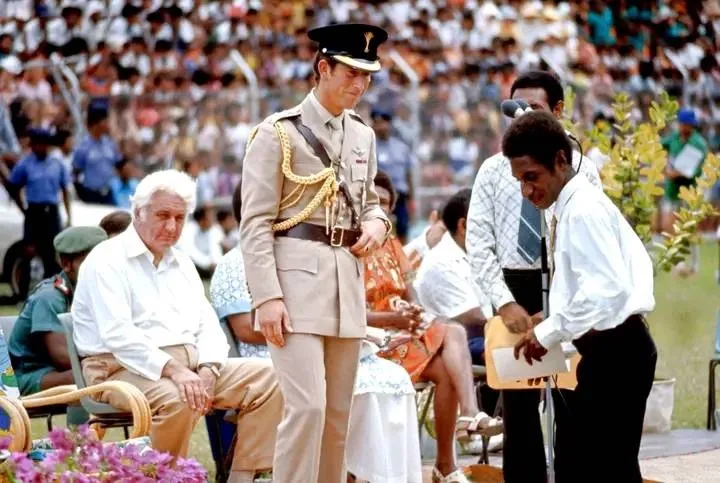
Prince Charles at the 1975 Indepedence Day of PNG. Source: PNG Government.
Before the Birth: Colonial Threads and Self-Determination
To understand that moment, one must trace the story of how Papua New Guinea came to stand on its own.
The southern region, Papua, was declared a British protectorate in 1884 before being handed to Australia for administration. The northern region, New Guinea, was colonized by Germany in the late 19th century, seized by Australian forces in World War I, and then placed under a League of Nations mandate. After World War II, both territories were united under Australian control and administered from Canberra as the Territory of Papua and New Guinea.
Through the 1960s and early 1970s, Papua New Guineans began to enter representative government. Elections were held in 1964, 1968, and 1972, culminating in self-government in December 1973. The Australian Parliament then passed the Papua New Guinea Independence Act 1975, ending all remaining sovereignty claims effective 16 September 1975.
A major constitutional debate shaped PNG’s founding: whether to become a republic or remain a Commonwealth realm retaining the Queen as head of state. After deliberations, on 15 August 1975, the Constituent Assembly adopted a constitution recognizing the Queen, represented by a Papua New Guinean Governor General, Sir John Guise.
Thus, PNG entered independence not in revolution but in reconciliation, seeking both self-determination and continuity.
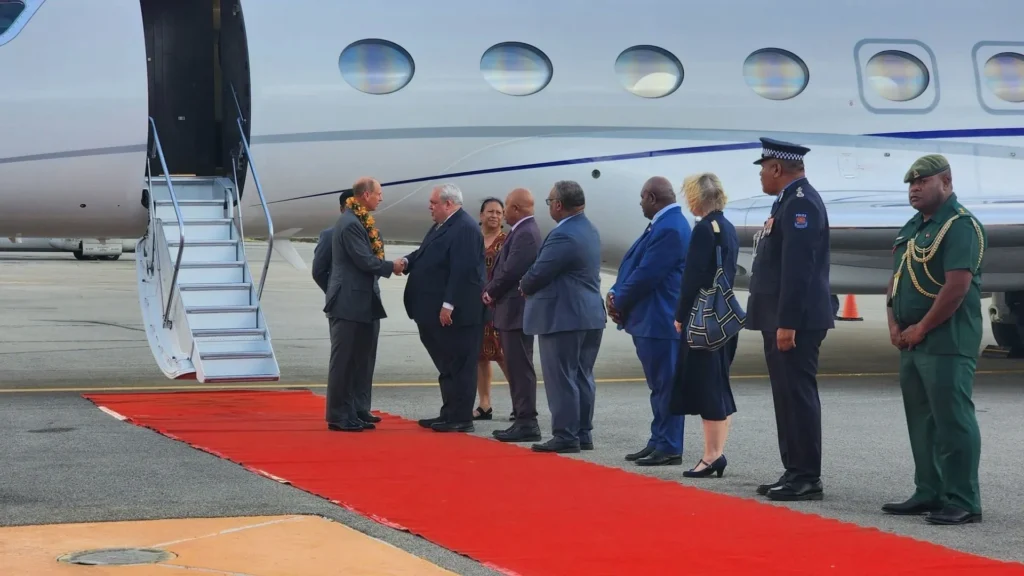
Prince Edward arrival for the Independence Day celebration, greated by Minister for Foreign Affairs Hon. Justin Tkatchenko and other delegates. Source: PNG Defence Force.
1975: The Ceremony that Changed Everything
At Sir Hubert Murray Stadium, the grandstands filled with thousands in attendance, and later at Independence Hill for the flag raising ceremony. The atmosphere gave a feeling of anxiety and excitement. Dancers in kundu and bilas waited patiently. Across the bay, Australian naval warships stood at anchor, marking the historic transition.
Prince Charles, representing Queen Elizabeth II, addressed the crowd, welcoming Papua New Guinea into the Commonwealth and conveying the Queen’s regards and affection.
Australian Prime Minister, Gough Whitlam told the audience, recorded in the Australian Government official page, “This is a day that will live in history”.
Sir John Guise, the Governor General of Papua New Guinea, in reference to the Australian flag declared in his speech:
“We are lowering it, not tearing it down.”
After the proclamation of independence by Sir John, this was followed by the PNG national anthem and 101-gun salute from the Royal Australian Navy. Fireworks and celebrations continued as the skies lite up.
By dawn, the world had a new nation.
Michael Somare, the Chief Minister of Papua New Guinea and the country’s first Prime Minister after independence, addressed the people, urging unity and humility. Sir John Kerr, Governor General of Australia attended alongside regional leaders from the Pacific.
The emotion of the day lingered long after the speeches. Across the highlands and islands, communities celebrated in their own ways. Local accounts tell of confusion, villagers reportedly cut down a newly raised flagpole, unsure of its meaning.
But in Port Moresby, the young prince Charles smiled quietly as fireworks rose above the capital. History had changed forever.
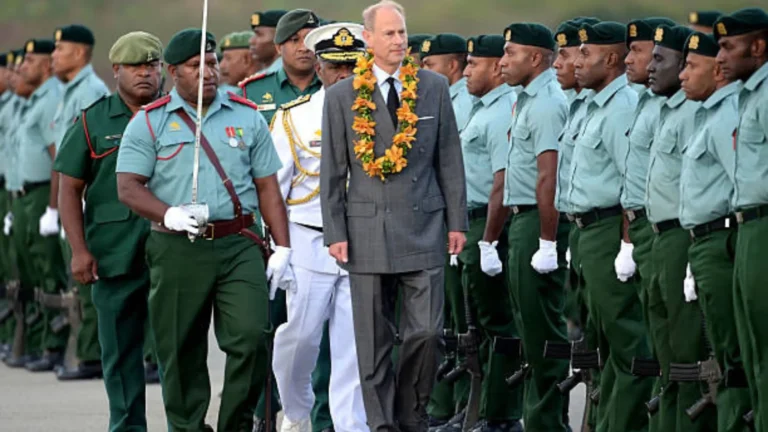
Prince Edward inspects a guard of honor on his arrival at Jacksons International Airport for the Independence Day celebrations. Source: PNG Defence Force.
2025: The Golden Jubilee, The Crown Returns
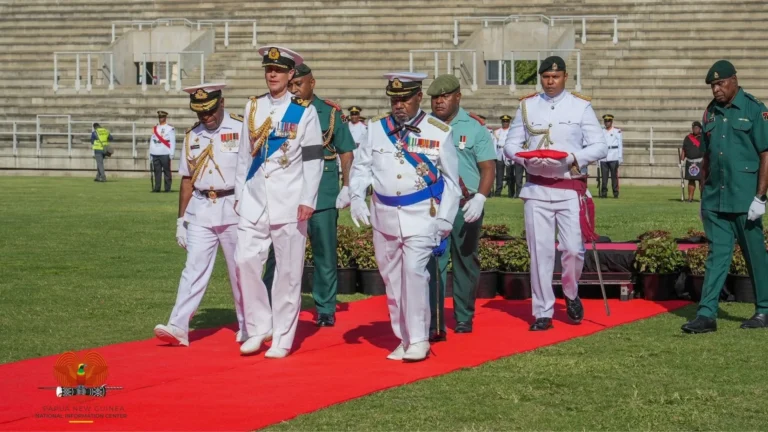
On 14 September 2025, Prince Edward, Duke of Edinburgh, arrived in Port Moresby to represent King Charles III at Papua New Guinea’s 50th Independence Anniversary. At the Airport, he arrived to a red-carpet welcome, befitting his royal station. Guided by Acting Chief of Protocol, Mr Lucus Manduru, Minister for Foreign Affairs, Hon. Justin Tkatchenko was there to greet him. Followed by other Dignitaries, Senior Military staff and Commissioner of Police, David Manning. Finally, after greeting Rear Admiral Philip Polewara, the Commander of the PNG Defense Force, he was escorted to the stage with the PNG Flag flying high. A 21-gun salute greeted the Prince and he inspected the guard of honour, and later met Governor-General Sir Bob Dadae at Government House.
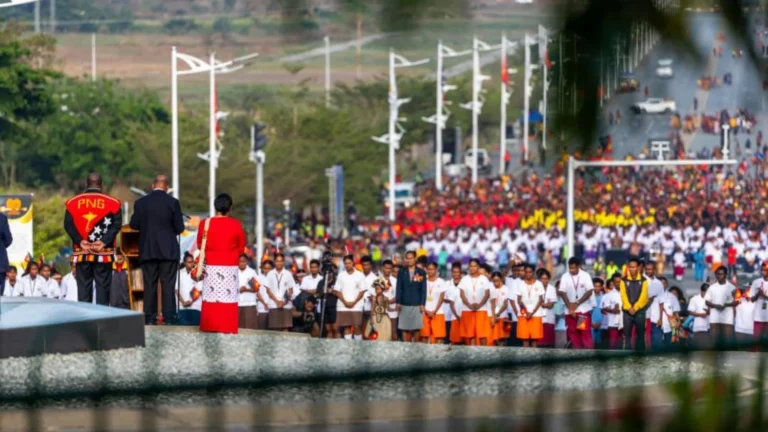
At Independence Hill, Dignitaries addressing the crowd on Independence Day. Source: PNG Defence Force.
Over three days, the Duke attended official engagements blending ceremony, culture, and community:
- Flag Ceremonies
At dawn on 16 September, he joined the flag-raising at Independence Hill, where the PNG flag flew beside the Union Jack. Later, at Sir Hubert Murray Stadium, he participated in the flag-lowering ceremony, a re-enactment of the 1975 ritual that had once marked independence.
- Presentation of Regimental Colours
The Duke presented new Regimental Colours to the 1st Battalion, Royal Pacific Islands Regiment, replacing those issued under Queen Elizabeth II. The act symbolized continuity and respect for the military’s service and loyalty.
- King’s Message
King Charles III, delivered a speech via video in both English and Tok Pisin, as per the official Royal page, an extract whereby he stated:
“On this day of joyful celebration, I recall with fond nostalgia the moment when the flag of Papua New Guinea was raised high on Independence Hill fifty years ago. I was there. On that historic occasion, we looked with hope and anticipation to the future of a proud new nation. Today, as you mark this important milestone, we can look back with admiration at the achievements and progress of the past five decades as an independent, democratic state”.
- Civic & Cultural Engagements
Prince Edward visited Wanigela village near Port Moresby, meeting youth groups, church leaders, and women’s cooperatives. He accepted a kina shell, a traditional symbol of friendship and respect. He also visited Waigani National Court, emphasizing the rule of law, and officiated at an investiture ceremony awarding the 50th Independence Anniversary King’s Medals to distinguished citizens.
- International Attendance
Leaders and envoys from across the world joined the celebrations, including Australia, Prime Minister Anthony Albanese, Solomon Islands, Prime Minister, Jeremiah Manele, Cook Islands, Prime Minister, Mark Brown, Tonga’s Crown Prince, Tupouto ‘a ‘Ulukalala, Prime Minister of Niue, Dalton Tagelagi, Prime Minister of Tuvalu, Feleti Teo, President of Federated States of Micronesia, Wesley Simina and Palau’s President, Surangel Whipps Jr. High level delegation from the Commonwealth countries and other Pacific Island dignitaries also attended. Japan and United States sent high-level delegation for the 50th Celebrations.
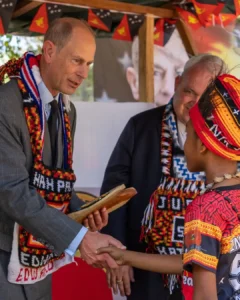
Prince Edward receives a gift from a young girl during his tour of Wanigela Village, Port Moresby. Source: PNG Government
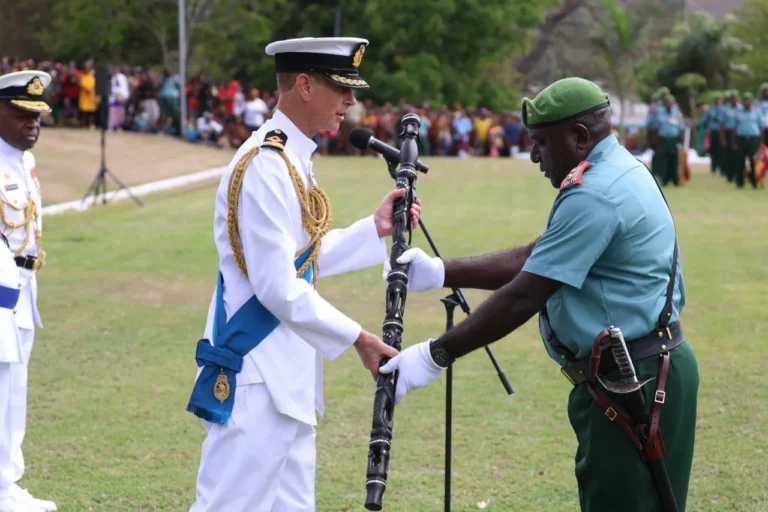
Prince Edward receives the ceremonial sword from PNG Defence Force. Source PNG Defence Force.
The Royal Australian Air Force staged a flyover, and the PNG Defence Force performed a 50-gun salute on Independence Hill.
During his Independence Day speech, Prime Minister James Marape stated:
“Independence was born not out of anger, but out of respect and humility, and faith in the future.”
In his speech, Prince Edward highlighted it was a great pleasure for him to be part of the 50th Independence and nationhood. He was appreciative of the wonderful welcome he received over the last few days of his stay in Papua New Guinea, it was very special for him and he thanked the audience. The crowd roared to the sounds of the beating drum and appreciated every word the prince uttered. The skies lite up with fireworks, an aerial drone display illuminated the night sky, forming the Southern Cross and Bird of Paradise, cementing Papua New Guinea’s place on this day of Independence.
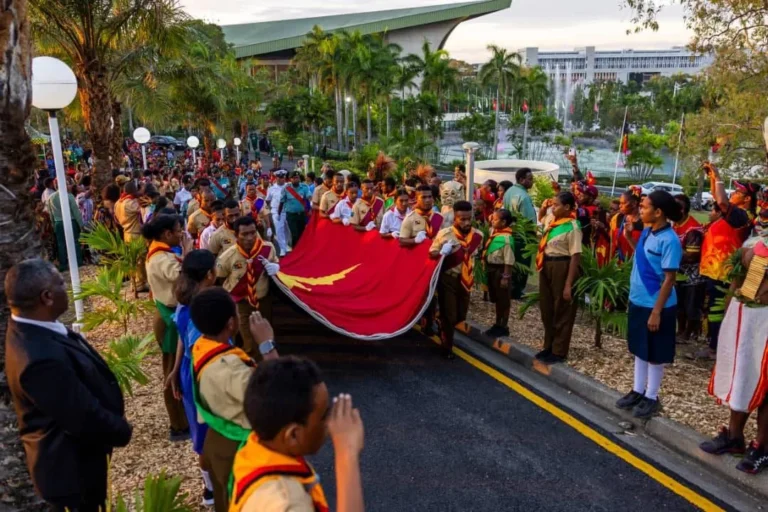
Flag raising ceremony, reenactment of 1975 Independence Day. Source: PNG Defence Force.
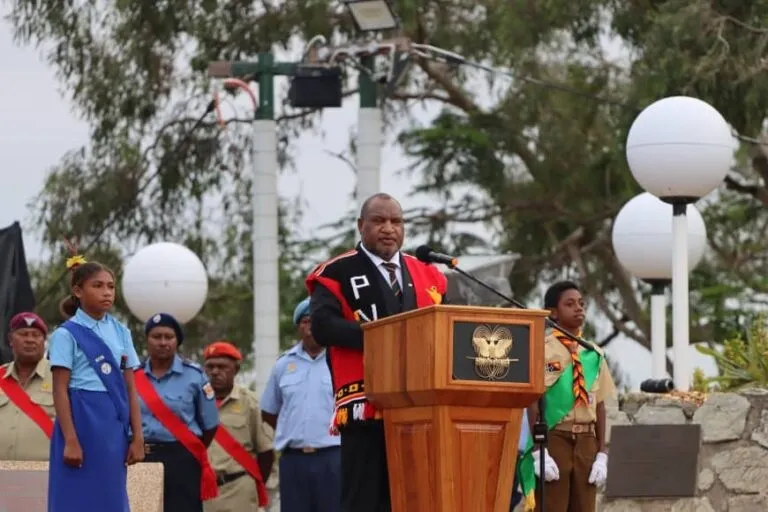
Prime Minister Hon. Marape's speech at Independence Hill. Source: PNG Defence Force.
Human Reflections: From Past to Present
Speaking to ABC News, Ms Somare-Brash stated, “I am so proud. I’m such a proud Papua New Guinean. We did that in a really short period of time, so imagine what we’re going to be able to do in 50 years.” One of the local villages involved in the dance celebration for Independence Day, highlighted in a video clip by ABC News, “I am happy, to celebrate, to represent, not only where I came from, my province, but also Papuan New Guinea as a whole”.
For many, the jubilee was not just a reminder of history, but a bridge between generations. Students born long after independence watched archival footage of Prince Charles standing at Independence Hill, hearing his brother’s words echo half a century later.
Ordinary citizens watched as Prince Edward’s motorcade drove by. In villages around Port Moresby, children danced barefoot in red, yellow, and black. For them, independence was not nostalgia, but heritage.
The symbolism of the Crown remains complex. To some, it represents colonial memory; to others, friendship, stability, and respect. But for most, it now serves as a living link to a wider Commonwealth community.
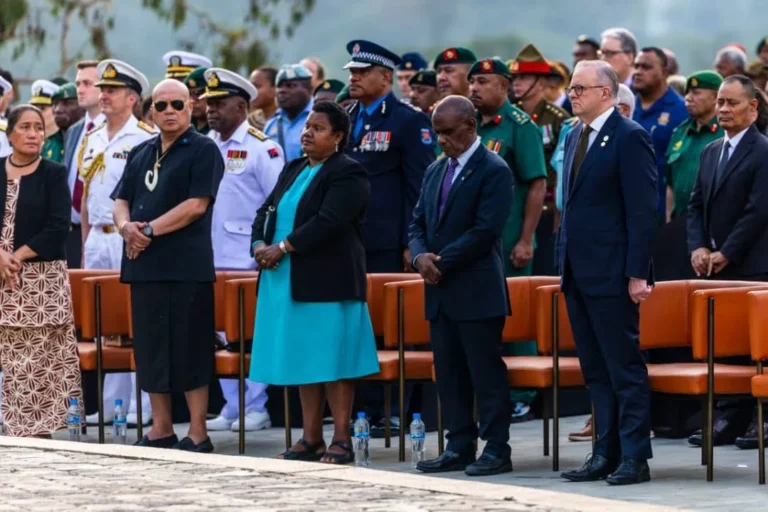
Australian Prime Minister, Anthony Albanese on the right and other dignitaries at Independence Hill, celebration of PNG Independence Day. Source: PNG Defence Force.
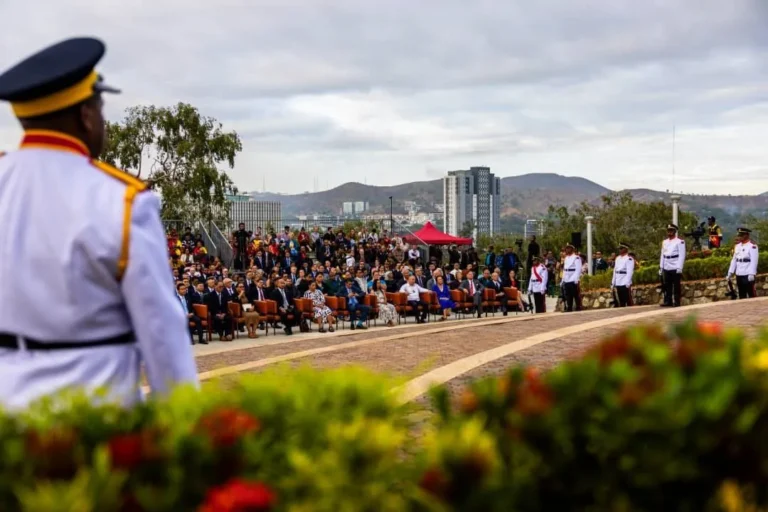
The dignitaries and leaders in attendence at Independence Hill, Independence Day celebrations. Source: PNG Defence Force.
A Journey of Continuity
When Prince Charles stood on Independence Hill in 1975, he embodied the end of the empire. When Prince Edward stood in the same city in 2025, he represented something more subtle, continuity without control, friendship without dominion.
Papua New Guinea’s journey between those two moments has been profound. From early struggles for self-rule to modern aspirations for regional leadership, its story reflects resilience and pride.
Fifty years on, independence remains firmly under the destiny of people of Papua New Guinea, not only in sovereignty, but also in spirit. Yet the jubilee, marked by the Crown’s return, reminded all that history is not only written in documents and decrees, but also in faces, songs, and memories shared under a rising flag.