Informing Today, Inspiring Tomorrow

Informing Today, Inspiring Tomorrow
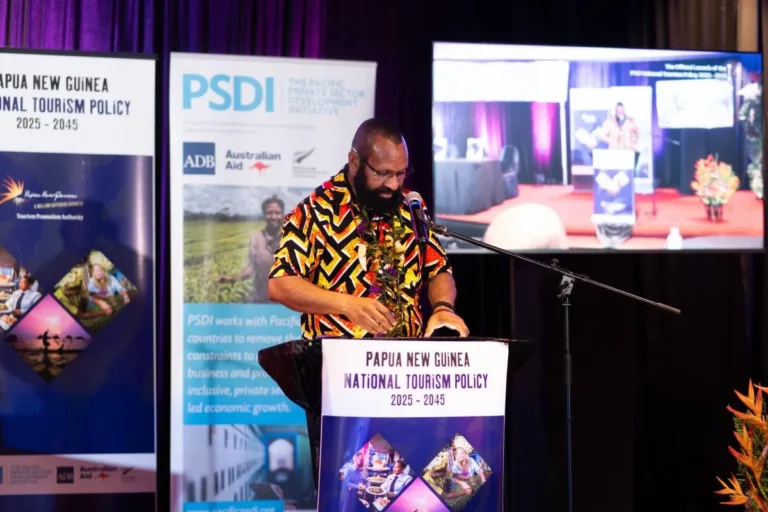
Source: The Pacific Private Sector Development Initiative
A New Chapter for Tourism: What the National Tourism Policy Means for the Nation
Papua New Guinea’s National Tourism Policy 2025–2045 marks a defining moment for a sector long recognised for its potential, yet often constrained by distance, infrastructure gaps and fragmented coordination. Nearly three decades after the country’s first tourism policy was introduced, this new framework sets out a clear, modern and ambitious vision for tourism to become a sustainable pillar of national development
PNGTPA-National-Tourism-Policy-More than a policy document, it is a statement of intent: that tourism can help diversify PNG’s economy, create inclusive employment, empower landowners and protect the nation’s extraordinary cultural and natural heritage for generations to come.
Tourism as a National Development Tool
At the heart of the policy is a shared national vision that tourism will be a “thriving and resilient economic sector” for Papua New Guinea, recognised globally for compelling visitor experiences and best practice in sustainable and inclusive development.
This is a significant reframing of tourism’s role. Rather than viewing tourism as a niche or supplementary activity, the policy positions it as a serious contributor to economic growth, employment and small business development. In a country seeking to reduce its dependence on extractive industries, tourism offers a renewable economic pathway, one that leverages PNG’s people, culture and environment rather than depleting finite resources.
The policy aligns tourism with national development priorities under PNG Vision 2050 and the Medium-Term Development Plan, reinforcing the sector’s role in job creation, SME growth and regional development.
Playing to PNG’s Strengths
One of the policy’s most important contributions is its realistic understanding of PNG’s competitive position. Rather than pursuing mass tourism, the policy focuses on high-value, niche markets that align with PNG’s strengths: eco-tourism, adventure tourism, cultural heritage, diving, birdwatching and war history tourism.
This approach recognises that PNG’s appeal lies in authenticity. With more than 800 languages, rich living cultures and some of the world’s most intact ecosystems, PNG offers experiences that cannot be replicated elsewhere. By targeting travellers who value these attributes, the policy seeks to maximise economic returns while protecting social and environmental integrity.
For PNG, this means fewer visitors creating greater value, rather than large volumes placing pressure on communities and fragile environments.
Empowering Landowners and Communities
A major strength of the policy is its explicit recognition of resource custodians and host communities as central partners in tourism development. In a country where customary land ownership is the norm, this acknowledgment is both practical and transformative.
The policy commits government to protecting landowner interests, enabling participation and ensuring that communities benefit directly from tourism activity. This includes support for community-based tourism enterprises, MSMEs and locally owned tourism ventures
For rural PNG, this is particularly significant. Tourism can bring income, skills and opportunities to areas where formal employment is limited. When properly supported, tourism enterprises can strengthen local economies while reinforcing pride in culture and heritage.
Building a Sustainable Future
Environmental sustainability is embedded throughout the policy as a cross-cutting priority. PNG’s forests, reefs, mountains and wildlife are central to its tourism appeal, and the policy recognises that protecting these assets is essential not only for tourism, but for national wellbeing.
Commitments to stronger environmental standards, visitor management, carrying-capacity planning and climate resilience position tourism as a partner in conservation rather than a threat. The policy also opens the door for innovative mechanisms such as a Green Fee, allowing visitors to contribute directly to conservation and climate-compatible tourism development.
This approach aligns PNG with global trends, where travellers increasingly seek destinations that demonstrate responsible environmental stewardship.
Strengthening Governance and Coordination
Tourism’s dependence on multiple sectors has long been a challenge. The new policy addresses this head-on through a whole-of-government approach, recognising that success requires coordination across transport, infrastructure, immigration, security, environment, health and provincial administrations.
By clarifying roles and committing agencies to shared outcomes, the policy lays the groundwork for stronger governance and more effective delivery. The Tourism Promotion Authority is positioned as the national lead agency, supported by sector partners and provincial governments through structured planning and implementation mechanisms.
For PNG, this represents a move away from fragmented decision-making towards a more integrated development model.