Informing Today, Inspiring Tomorrow

Informing Today, Inspiring Tomorrow
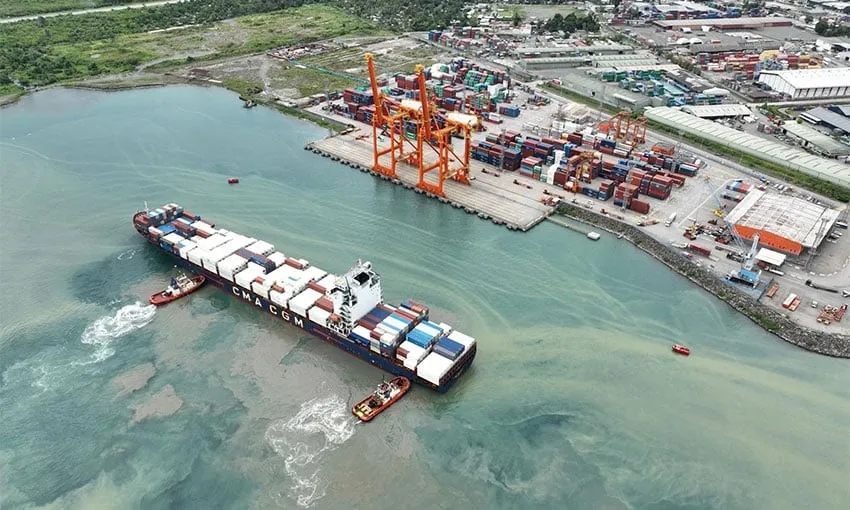
Source: ICTSI South Pacific
Ports, People and the Pacific: How PNG’s Gateway Is Powering Trade
Why this matters now
PNG is the largest economy among the Pacific Island countries and the most populous, with an official estimate by the National Statistical Office, PNG of 11, 781,559 people in 2021. Geography gives it leverage: perched at the seam between Melanesia and Southeast Asia, PNG sits on the shipping pathways that connect Northeast Asia with the South Pacific and Australia. Those structural advantages underpin trade, from minerals to coffee, and shape economic prospects.
After a slower patch, growth re-accelerated in 2024. The Asian Development Outlook (April 2025) attributes the pickup to both resource and non-resource activity and projects GDP growth of 4.2% in 2025, easing to 3.8% in 2026. The World Bank is more upbeat on 2025, penciling in 4.7% after an estimated 3.8% in 2024, a useful range for planners and investors to watch.
Commodity tailwinds have helped. Cocoa and coffee prices surged through 2024, boosting farmgate incomes and export receipts, while the metals index rose on energy-transition demand for copper, important for PNG’s pipeline.
Economic growth and rising commodity prices induce higher supply, while price declines stimulate demand, either way, throughput increases and challenges PNG ports’ capacity.
The port pivot since 2017
A decisive shift came in 2017, when PNG Ports signed 25-year terminal concessions with International Container Terminal Services Inc. (ICTSI) for Lae’s South Pacific International Container Terminal (SPICT) and Motukea International Terminal (MIT). The goal was straightforward: bring in a specialist operator to modernise two national gateways.
Three years later, measurable wins were on the board. Average vessel turnaround fell from 38 hours to 18, truck turnaround halved to 25 minutes, and electronic data exchange also improved. Those are not abstract KPIs; they are cost, cash-flow, and shelf-life for importers and exporters. Digitisation is part of the lift. The introduction of the world class terminal run Navis N4, a leading terminal operating system, further improved the flow of goods, it lets shippers and forwarders track boxes and streamline gates and yard moves.
Lifting bigger, sailing faster
In 2022, ICTSI unit in the Pacific, known as International Container Terminal South Pacific (ICTSI), received PNG’s first ship-to-shore (STS) quay cranes, Post-Panamax units with a reach of 17 rows were able to work ships of up to 6,000 TEU. Apart from that, it had also invested in additional new rubber gantry cranes, 2.5-Megawatt Cummins power generators, truck trailers and container handlers. Staff were sent to ICTSI’s flagship terminal in Manila for hands on training. The aim was explicit: bigger ships, shorter port stays, lower logistics costs for PNG firms.
The payoff became visible for PNG Ports on 25 February 2025, when the 261-metre CMA CGM Perth berthed at the Lae Tidal Basin, the longest container ship to call PNG. The call leaned on infrastructure upgrades commissioned in late 2024 (mooring dolphin and 100-ton bollards) and demonstrates Lae’s growing ability to handle gearless mainliners.
It’s not just marketing hype. Independent industry trackers place ICTSI among the world’s top 10 terminal operators, and regional business reporting shows vessel wait times and move rates improving at both Lae and Motukea since 2017.
Tying ports to the macro picture
Reforms are moving beyond quay lines. PNG’s foreign-exchange shortages, a cost and planning headache for importers, have eased, with the FX order backlog falling from 1 to 4 weeks in late 2024 to under a week in early 2025, according to Asian Development Bank’s April 2025 country brief. This was assisted by the central bank adopting a crawling depreciation mechanism. That’s a direct help to firms trying to clear inputs and repay suppliers on time.
On the resource side, the Porgera gold mine restarted after a multi-year shutdown, with first gold in Q1 2024 and ramp-up through 2024–25, another swing factor for export earnings and government revenues.
These impacts will benefit businesses and will assist the flow of goods moving in and out of the Ports and making PNG firms more competitive in the global region.
Headwinds to watch
Business leaders still cite power unreliability, security concerns, and the cost of doing business as it drags on competitiveness. In August 2025, the Papua New Guinea Chamber of Commerce and Industry mentioned to the “The National” and warned about the impact of frequent outages on firms, the International Monetary Fund also highlights security risks alongside the macro gains. Notably, the terminal operator has partly insulated Lae with dedicated generator to maintain its operations, but economy-wide reliability remains a reform priority.
While security issues need a holistic effort from all stakeholders, earlier, In June,Hon. Thomas Opa, who was the Minister for Energy before taking up the Finance portfolio, mentioned to “ABC Pacific” that the problem is with the constant supply of diesel fuel and the ageing infrastructure. He further stressed the government’s plan, “National Energy Rollout Plan”, which aims to provide 70 percent electricity access to Papua New Guineas by 2030.
While aging infrastructure will take sometime to fix and the power issue won’t be solved overnight, it’s clear the government has a direction. One of the strategies is the deregulation of the energy sector to allow the private sector to bring in the technology and the infrastructure. This will allow for mini-hydro, solar and wind power.
The regional play: hub logic
With its scale among Pacific Island economies, proximity to Asian trade lanes, and now heavier-lift, faster-turn terminals, PNG is positioned to capture more direct calls and transhipment within Asia Pacific region and the West North-South trade lanes. That is exactly how logistics costs fall over time, larger vessels, fewer handoffs, faster turns. Getting there will take steady investment in berths, power, customs digitisation, and safe corridors to and from the gates, but the direction of travel is clear.
Bottom line
From independence to its golden jubilee, PNG’s economic story has always hinged on connection—between highlands and harbours, producers and buyers, islands and continents. The 2017 port concessions, technology upgrades, and crane capacity have already squeezed hours out of the supply chain and opened doors to larger ships. Pair those gains with improving FX availability, a Porgera restart, and buoyant agriculture and metals prices through 2024, and the trade engine looks stronger than it has in years. Keeping it that way will mean fixing power, staying the course on reforms, and continuing to invest where it counts: at the quay, at the gate, and on the road beyond.