Informing Today, Inspiring Tomorrow

Informing Today, Inspiring Tomorrow
Reform, Resources and Leadership
When James Marape became Papua New Guinea’s Prime Minister in May 2019, he made a promise that struck a chord with many: to “Take Back PNG” so that more of the country’s wealth stays with its people.
Since then, this pledge has guided his government’s direction, shaping how it negotiates major resource projects, builds infrastructure, supports small business, and positions PNG in the wider region. For the business community, it has meant a more confident government that seeks a fairer share, while still recognising that real growth comes when enterprise is allowed to thrive.
Roots and Resolve
Born in Tari in Hela Province, Hon. Marape’s journey reflects the hopes of many ordinary families in PNG. He studied at the University of Papua New Guinea, then worked in management and public administration before entering parliament in 2007 as the member for Tari-Pori. He served as Minister for Education under Sir Michael Somare and later as Minister for Finance, before becoming PNG’s ninth Prime Minister on 30 May 2019. In 2022, he won another mandate and continues to lead the Pangu Party in coalition.
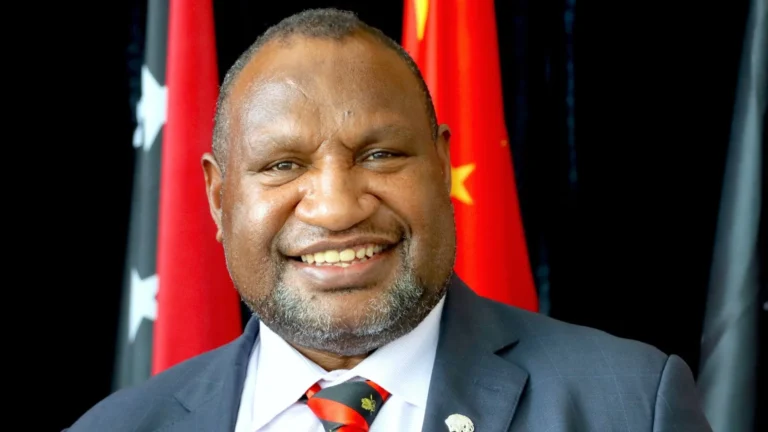
Hon. James Marape. Source: PM Media.
Hon. Marape is often described as a leader driven by his values, grounded in his faith and guided by the belief that PNG should be “a friend to all,” while standing firm on protecting the nation’s economic interests. This combination of principle and determination has defined his leadership style.
The “Take Back PNG” Economic Agenda
From his first day as Prime Minister, Hon. Marape pushed for stronger terms in resource deals. His goal was clear: give more ownership and benefits to the state and landowners, increase PNG’s role in downstream processing, and make sure agreements last through good and bad times in the global market. For many, “Take Back PNG” is not just about negotiating contracts, it is also about building confidence and capacity within the nation.
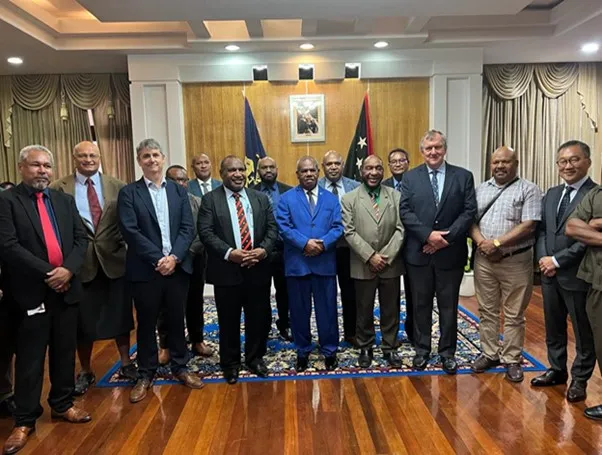
The Governor-General Sir Bob Dadae (centre), Prime Minister Hon. James Marape, Barrick Gold Corporation President and CEO Mark Bristow, company representatives, Enga Governor Hon. Sir Peter Ipatas, Ministers and MPs, Porgera landowner representatives, members of the State Negotiating Team, after the signing of four Agreements at Government House on Friday 13 October 2023. Source: DICT, PNG Government.
This approach has been most visible in three major resource projects that are critical for PNG’s economy:
Porgera (gold): After years of closure and tough talks, the mine reopened in December 2023 under a new arrangement, New Porgera, where PNG interests, including landowners, hold the majority share. By early 2024, production resumed and revenue started flowing. For Enga, this meant jobs and supply chains reopening. For PNG as a whole, it showed that even the most difficult negotiations can be resolved in ways that benefit the country.
Papua LNG (gas): This project, led by TotalEnergies and partners, is moving forward with a final investment decision targeted for 2025. With its long-term export potential and access to Asian markets, Papua LNG is a vital project for PNG’s future. The government’s challenge is to secure strong local benefits while keeping the project attractive to investors, a balancing act that captures the heart of the “Take Back PNG” philosophy.
P’nyang (gas): Negotiations over P’nyang were one of the first major tests of the government’s new approach. The state pressed for better terms than those of older projects. The clear message: PNG is open to investment, but deals must be fair, transparent, and bring value to its people. For companies, this may mean tougher negotiations, but it also brings greater certainty about what the government expects: stronger local involvement and fairer sharing of benefits.
Building the Foundations: Roads, Skills and Small Business
Hon. Marape’s economic plan isn’t just about resources. It is also about opening opportunities in other parts of the economy. Businesses have long complained that poor transport networks drive up costs. In response, the government launched Connect PNG (2020–2040), a 20-year program to build and upgrade highways, ports and airports, linking rural markets to urban centres. Better roads and transport mean lower costs for businesses and easier access for farmers, traders and customers.
Education has also been a focus. The Higher Education Loan Programme (HELP), introduced in 2020, has made it easier for students to afford university and training by spreading out their payments. Over time, this means more skilled graduates entering the workforce, good news for businesses needing accountants, engineers, IT specialists, health workers and tradespeople.
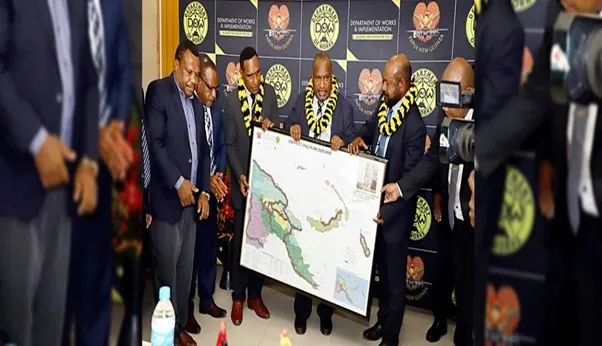
Prime Minister, James Marape with Department of Works, Connect PNG Policy 2020 – 2040. Source: Post Courier/PCADMINPNG.
On the business side, Hon. Marape has supported SME and MSME finance by establishing a K200 million concessional loan facility. Hundreds of small and medium businesses across the country have already accessed these loans, with flexible repayment terms designed for PNG’s business environment. Alongside targeted programs in farming and fisheries, these efforts aim to grow the economy beyond mining and gas, and give more Papua New Guineans the chance to build businesses of their own.
Governance and Institutions
For businesses, stability and fair rules are essential. That’s why the government supported the creation of the Independent Commission Against Corruption (ICAC), passed into law in 2020 and brought to life with the appointment of commissioners in 2023. The ICAC is expected to improve trust in government contracts and reduce unfair practices. Hon. Marape has also backed investigations into past financial decisions, including the UBS loan, showing a willingness to face difficult issues. Change won’t happen overnight, but the direction is clear: stronger rules and fairer governance to support both citizens and investors.
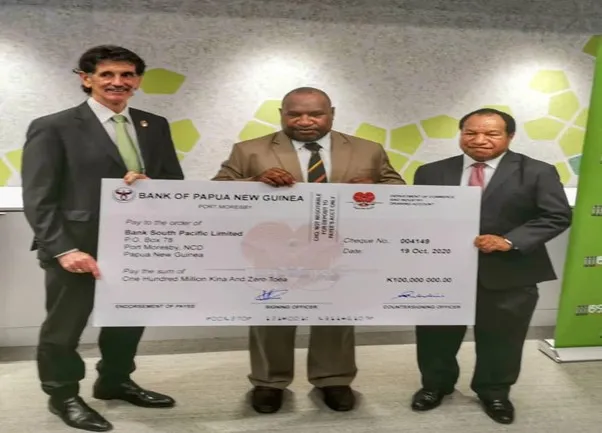
Prime Minister James Marape (centre) and Minister for Commerce William Duma (right) present a cheque for K100 million to Bank South Pacific CEO Robin Fleming (left) for Small to Medium Enterprises, 2020. Source: MSME Council.
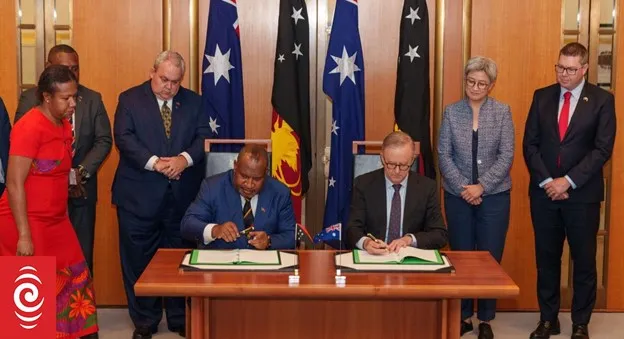
PNG Prime Minister, James Marape and Australian Prime Minister, Anthony Albanese signed a bilateral security agreement on 7th December, 2023. Source: Facebook.com/Anthony Albanese.
Alongside domestic reforms, Hon. Marape has been active abroad. In December 2023, PNG signed a Bilateral Security Agreement with Australia, which came into effect in 2024. This deal covers policing, border management and disaster response, important for businesses because security and rule of law affect investment decisions and costs.
In February 2024, Hon. Marape became the first Pacific leader to address the Australian Parliament, highlighting PNG’s growing role in the region. His visit also secured Australian support for PNG’s internal security, another factor that improves confidence for businesses operating in the country. Hon. Marape’s wider message to the world has been simple: PNG is open for business with all partners, but on terms that respect its sovereignty and deliver lasting value to its people.
What This Means for Business
For resource companies, the lesson of recent years is clear: deals must deliver real benefits to communities and to PNG itself. While this can make negotiations longer, it reduces the risk of disputes later. The reopening of Porgera has restored one of PNG’s biggest revenue streams and has already begun creating jobs and opportunities for suppliers.
For other sectors, like farming, construction, and tourism, Connect PNG is creating the infrastructure needed to grow. As highways are completed and maintained, companies can move goods more reliably and reach more customers.
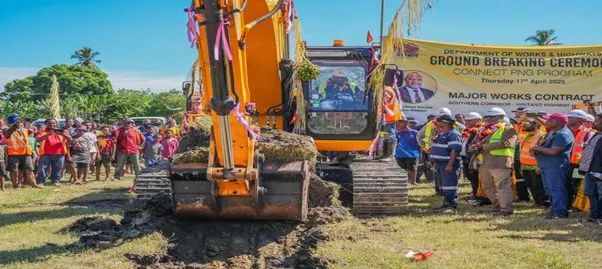
Prime Minister Hon. James Marape during the groundbreaking of the Southern Corridor – Hiritano Highway Redevelopment Project at Bereina Station, KairukuHiri, Central Province on Thursday 17 April, 2025. Source: PNG National Information Centre.
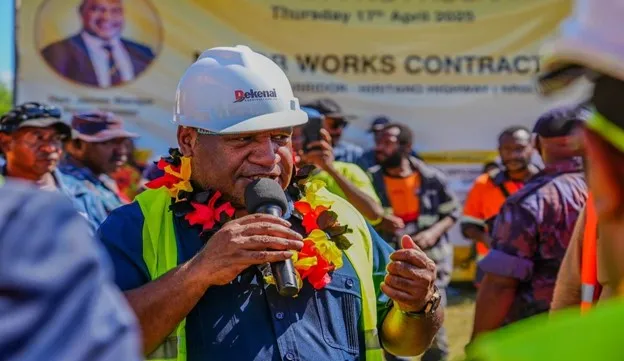
Prime Minister Hon. James Marape giving a speech during the groundbreaking of the Southern Corridor – Hiritano Highway Redevelopment Project at Bereina Station, KairukuHiri, Central Province on Thursday 17 April, 2025. Source: PNG National Information Centre.
Meanwhile, initiatives like HELP loans and SME credit schemes may take longer to show results, but they are laying the groundwork for a stronger local business class and a more skilled workforce.
Leadership Shaped for Long-term Gains
Hon. Marape’s style is a mix of high-level negotiation and grassroots connection. He can be found in boardrooms with global CEOs, but also speaking directly with small business owners in Lae or Mt Hagen. His government’s message is that protecting national interests and encouraging growth are not opposites, they go hand in hand.
This has been seen in:
- Stronger deals with delivery: Tougher terms for projects, but also getting them moving again (e.g. Porgera and Papua LNG).
- Opening doors for participation: Ensuring training, jobs and loans allow more Papua New Guineans to share in growth.
- Building institutions: Establishing ICAC and supporting reforms to create a fairer, more predictable environment for business.
The Road Ahead
Two milestones will be especially important in the near future. First, the final investment decision on Papua LNG in 2025, which will mark the start of PNG’s next big LNG chapter. Second, the ongoing rollout of Connect PNG, which will determine whether improved transport truly lowers costs and boosts commerce across the country.
Since 2019, Hon. Marape’s message has been consistent: PNG must be the main winner from its resources, and the government must do the heavy lifting in building skills, infrastructure and institutions so the private sector can succeed. For businesses, this means a Prime Minister committed to long-term growth, partnership, and turning ambition into real projects.
PNG’s development path will not be simple, but under Hon. James Marape its direction is clearer: negotiate fairly, build the basics, open opportunities for all, and ensure the nation’s wealth benefits its people while keeping the door open to those ready to invest in PNG’s future.
Highlights of Marape’s Leadership:
- Reopened Porgera Gold Mine under majority PNG ownership.
- Advanced Papua LNG towards final investment in 2025.
- Launched Connect PNG, a 20-year national roads program.
- Introduced HELP loans for university students.
- Established ICAC to fight corruption.
- Signed Bilateral Security Agreement with Australia.
Note: This article was first produced in the September, 2025 edition of the Niugini Review Magazine. Click below for the publication.